
in a net of good and evil… there is no other story.
Showing posts with label Fairy tales. Show all posts
Showing posts with label Fairy tales. Show all posts
Mar 28, 2012

Jan 8, 2012

Dec 28, 2011
The Snow Queen

The Snow Queen
by Hans Christian Anderson
FIRST STORY. Which Treats of a Mirror and of the Splinters
Now then, let us begin. When we are at the end of the story, we shall know more than we know now: but to begin.
Once upon a time there was a wicked sprite, indeed he was the most mischievous of all sprites. One day he was in a very good humor, for he had made a mirror with the power of causing all that was good and beautiful when it was reflected therein, to look poor and mean; but that which was good-for-nothing and looked ugly was shown magnified and increased in ugliness. In this mirror the most beautiful landscapes looked like boiled spinach, and the best persons were turned into frights, or appeared to stand on their heads; their faces were so distorted that they were not to be recognised; and if anyone had a mole, you might be sure that it would be magnified and spread over both nose and mouth.
"That's glorious fun!" said the sprite. If a good thought passed through a man's mind, then a grin was seen in the mirror, and the sprite laughed heartily at his clever discovery. All the little sprites who went to his school--for he kept a sprite school--told each other that a miracle had happened; and that now only, as they thought, it would be possible to see how the world really looked. They ran about with the mirror; and at last there was not a land or a person who was not represented distorted in the mirror. So then they thought they would fly up to the sky, and have a joke there. The higher they flew with the mirror, the more terribly it grinned: they could hardly hold it fast. Higher and higher still they flew, nearer and nearer to the stars, when suddenly the mirror shook so terribly with grinning, that it flew out of their hands and fell to the earth, where it was dashed in a hundred million and more pieces. And now it worked much more evil than before; for some of these pieces were hardly so large as a grain of sand, and they flew about in the wide world, and when they got into people's eyes, there they stayed; and then people saw everything perverted, or only had an eye for that which was evil. This happened because the very smallest bit had the same power which the whole mirror had possessed. Some persons even got a splinter in their heart, and then it made one shudder, for their heart became like a lump of ice. Some of the broken pieces were so large that they were used for windowpanes, through which one could not see one's friends. Other pieces were put in spectacles; and that was a sad affair when people put on their glasses to see well and rightly. Then the wicked sprite laughed till he almost choked, for all this tickled his fancy. The fine splinters still flew about in the air: and now we shall hear what happened next.
SECOND STORY. A Little Boy and a Little Girl
In a large town, where there are so many houses, and so many people, that there is no roof left for everybody to have a little garden; and where, on this account, most. persons are obliged to content themselves with flowers in pots; there lived two little children, who had a garden somewhat larger than a flower-pot. They were not brother and sister; but they cared for each other as much as if they were. Their parents lived exactly opposite. They inhabited two garrets; and where the roof of the one house joined that of the other, and the gutter ran along the extreme end of it, there was to each house a small window: one needed only to step over the gutter to get from one window to the other.
The children's parents had large wooden boxes there, in which vegetables for the kitchen were planted, and little rosetrees besides: there was a rose in each box, and they grew splendidly. They now thought of placing the boxes across the gutter, so that they nearly reached from one window to the other, and looked just like two walls of flowers. The tendrils of the peas hung down over the boxes; and the rose-trees shot up long branches, twined round the windows, and then bent towards each other: it was almost like a triumphant arch of foliage and flowers. The boxes were very high, and the children knew that they must not creep over them; so they often obtained permission to get out of the windows to each other, and to sit on their little stools among the roses, where they could play delight fully. In winter there was an end of this pleasure. The windows were often frozen over; but then they heated copper farthings on the stove, and laid the hot farthing on the windowpane, and then they had a capital peep-hole, quite nicely rounded; and out of each peeped a gentle friendly eye--it was the little boy and the little girl who were looking out. His name was Kay, hers was Gerda. In summer, with one jump, they could get to each other; but in winter they were obliged first to go down the long stairs, and then up the long stairs again: and out-of-doors there was quite a snow-storm.
"It is the white bees that are swarming," said Kay's old grandmother.
"Do the white bees choose a queen?" asked the little boy; for he knew that the honey-bees always have one.
"Yes," said the grandmother, "she flies where the swarm hangs in the thickest clusters. She is the largest of all; and she can never remain quietly on the earth, but goes up again into the black clouds. Many a winter's night she flies through the streets of the town, and peeps in at the windows; and they then freeze in so wondrous a manner that they look like flowers."
"Yes, I have seen it," said both the children; and so they knew that it was true.
"Can the Snow Queen come in?" said the little girl.
"Only let her come in!" said the little boy. "Then I'd put her on the stove, and she'd melt."
And then his grandmother patted his head and told him other stories.
In the evening, when little Kay was at home, and half undressed, he climbed up on the chair by the window, and peeped out of the little hole. A few snow-flakes were falling, and one, the largest of all, remained lying on the edge of a flower-pot.
The flake of snow grew larger and larger; and at last it was like a young lady, dressed in the finest white gauze, made of a million little flakes like stars. She was so beautiful and delicate, but she was of ice, of dazzling, sparkling ice; yet she lived; her eyes gazed fixedly, like two stars; but there was neither quiet nor repose in them. She nodded towards the window, and beckoned with her hand. The little boy was frightened, and jumped down from the chair; it seemed to him as if, at the same moment, a large bird flew past the window.
The next day it was a sharp frost--and then the spring came; the sun shone, the green leaves appeared, the swallows built their nests, the windows were opened, and the little children again sat in their pretty garden, high up on the leads at the top of the house.
That summer the roses flowered in unwonted beauty. The little girl had learned a hymn, in which there was something about roses; and then she thought of her own flowers; and she sang the verse to the little boy, who then sang it with her:
"The rose in the valley is blooming so sweet,
And angels descend there the children to greet."
And the children held each other by the hand, kissed the roses, looked up at the clear sunshine, and spoke as though they really saw angels there. What lovely summer-days those were! How delightful to be out in the air, near the fresh rose-bushes, that seem as if they would never finish blossoming!
Kay and Gerda looked at the picture-book full of beasts and of birds; and it was then--the clock in the church-tower was just striking five--that Kay said, "Oh! I feel such a sharp pain in my heart; and now something has got into my eye!"
The little girl put her arms around his neck. He winked his eves; now there was nothing to be seen.
"I think it is out now," said he; but it was not. It was just one of those pieces of glass from the magic mirror that had got into his eye; and poor Kay had got another piece right in his heart. It will soon become like ice. It did not hurt any longer, but there it was.
"What are you crying for?" asked he. "You look so ugly! There's nothing the matter with me. Ah," said he at once, "that rose is cankered! And look, this one is quite crooked! After all, these roses are very ugly! They are just like the box they are planted in!" And then he gave the box a good kick with his foot, and pulled both the roses up.
Dec 26, 2011
A Christmas Carol
In my top 5 fairy tales of all time.
A Christmas Carol
By Charles Dickens
Chapter 1
Marley's Ghost
Marley was dead, to begin with. There is no doubt whatever about that. The register of his burial was signed by the clergyman, the clerk, the undertaker, and the chief mourner. Scrooge signed it. And Scrooge's name was good upon 'Change, for anything he chose to put his hand to.
Old Marley was as dead as a door-nail.
Mind! I don't mean to say that I know, of my own knowledge, what there is particularly dead about a door-nail. I might have been inclined, myself, to regard a coffin-nail as the deadest piece of ironmongery in the trade. But the wisdom of our ancestors is in the simile; and my unhallowed hands shall not disturb it, or the Country's done for. You will therefore permit me to repear, emphatically, that Marley was as dead as a door-nail.
Scrooge knew he was dead? Of course he did. How could it be otherwise? Scrooge and he were partners for I don't know how many years. Scrooge was his sole executor, his sole administrator, his sole assign, his sole residuary legatee, his sole friend, and sole mourner. And even Scrooge was not so dreadfully cut up by the sad event, but that he was an excellent man of business on the very day of the funeral, and solemnised it with an undoubted bargain.
The mention of Marley's funeral brings me back to the point I started from. There is no doubt that Marley was dead. This must be distinctly understood, or nothing wonderful can come of the story I am going to relate. If we were not perfectly convinced that Hamlet's Father died before the play began, there would be nothing more remarkable in his taking a stroll at night, in an easterly wind, upon his own ramparts. that there would be in any other middle-aged gentleman rashly turning out after dark in a breezy spot -- say Saint Paul's Churchyard for instance -- literally to astonish his son's weak mind.
Scrooge never painted out Old Marley's name. There it stood, years afterwards, above the warehouse door: Scrooge and Marley. The firm was known as Scrooge and Marley. Sometimes people new ro the business called Scrooge Scrooge, and sometimes Marley, bur he answered to both names. It was all the same to him.
Oh! Bur he was a tight-fisted hand at the grindstone, Scrooge. A squeezing, wrenching, grasping, scraping, clutching, covetous old sinner! Hard and sharp as flint, from which no steel had ever struck out generous fire; secret, and self-contained, and solitary as an oyster, The cold within him froze his old features, nipped his pointed nose, shrivelled his cheek, stiffened his gait, made his eyes red, his thin lips blue; and spoke out shrewdly in his grating voice. A frosty rime was on his head, and on his eyebrows, and his wiry chin. He carried his own low temperature always about with him; he iced his office in the dog-days; and didn't thaw it one degree at Christmas.
External heat and cold had little influence on Scrooge. No warmth could warm, no wintry weather chill him. No wind that blew was bitterer than he, no falling snow was more intent upon its purpose, no pelting rain less open to entreary. Foul weather didn't know where to have him. The heaviest rain, and snow, and hail, and sleet, could boast of the advantage over him in only one respect. They often cam down handsomely, and Scrooge never did.
Nobody ever stopped him in the street to say, with gladsome looks, 'My dear Scrooge, how are you? When will you come to see me?' No beggars implored him to bestow a trifle, no children asked him what it was o'clock no msn or woman ever once in all his life inquired the way to such and such a place, of Scrooge. Even the blind men's dogs appeared to know him; and when they saw him coming on, would tug their owners into doorways and up courts; and then would wag their tails as though they said, 'No eye at all is better than an evil eye, dark master!'
But what did Scrooge care? It was the very thing he liked. To edge his way along the crowded paths of life, warning all human sympathy to keep its distance, was what the knowing ones call 'nuts' to Scrooge.
Once upon a time -- of all the good days in the year, on Christmas Eve -- old Scrooge sat busy in his counting-house. It was cold, bleak, biting weather: foggy withal: and he could hear the people in the court outside, go wheezing up and down, beating their hands upon their breasts, and stamping their feet upon the pavement stones to warm them. The city clocks had only just gone three, but it was quite dark already -- it had not been light all day -- and candles were flaring in the windows of the neighbouring offices, like ruddy smears upon the palpable brown air. The fog came pouring in at every chink and keyhole, and was so dense without, that although the court was of the narrowest, the houses opposite were mere phantoms. To see the dingy cloud come drooping down, obscuring everything, one might have thought that Nature lived hard by, and was brewing on a large scale.
The door of Scrooge's counting-house was open that he might keep his eye upon his clerk, who in a dismal little cell beyond, a sort of tank was copying letters. Scrooge had a very small fire, but the clerk's fire was so very much smaller that it looked like one coal. But he couldn't replenish it, for Scrooge kept the coal-box in his own room; and so surely as the clerk came in with the shovel, the master predicted that is would be necessary for them to part. Wherefore the clerk put on his white comforter, and tried to warm himself at the candle; in which effort, not being a man of a strong imagination, he failed.
'A merry Christmas, uncle! God save you!' cried a cheerful voice. It was the voice of Scrooge's nephew, who came upon him so quickly that this was the first intimation he had of his approach.
'Bah!' said Scrooge, 'Humbug!'
He had so heated himself with rapid walking in the fog and frost, this nephew of Scrooge's, that he was all in a glow; his face was ruddy and handsome; his eyes sparkled, and his breath smoked again.
'Christmas a humbug, uncle!' said Scrooge's nephew. 'You don't mean that, I am sure?'
'I do,' said Scrooge. 'Merry Christmas! What right do you have to be merry? What reason do you have to be merry? You're poor enough.'
'Come, then,' returned the nephew gaily. 'What right do you have to be dismal? What reason do you have to be morose? You're rich enough.'
Scrooge having no better answer ready on the spur of the moment, said, 'Bah!' again; and followed it up with 'Humbug!'
'Don't be cross, uncle.' said the nephew.
'What else can I be,' returned the uncle, 'when I live in such a world of fools as this? Merry Christmas! Out upon merry Christmas. What's Christmas time to you but a time for paying bills without money; a time for finding yourself a year older, but not an hour richer; a time for balancing your books and having every item in them through a round dozen of months presented dead against you? If I could work my will,' said Scrooge indignantly, 'every idiot who goes about with 'Merry Christmas' on his lips, should be boiled with his own pudding, and buried with a stake of holly through his heart. He should!'
'Uncle!' pleaded the nephew.
'Nephew!' returned the uncle, sternly, 'keep Christmas in your own way, and let me keep it in mine.'
'Keep it!' repeated Scrooge's nephew. 'But you don't keep it.'
'Let me leave it alone, then,' said Scrooge. 'Much good may it do you! Much good it has ever done you!'
'There are many things from which I might have derived good, by which I have not profited, I dare say,' returned the nephew. 'Christmas among the rest. But I am sure I have always thought of Christmas time, when it has come round - apart from the veneration due to its sacred name and origin, if anything belonging to it can be apart from that - as a good time; a kind, forgiving, charitable, pleasant time; the only time I know of, in the long calendar of the year, when men and women seem by one consent to open theur shut-up hearts freely, and to think of people below them as if they really were fellow-passengers to the grave, and not another race of creatures bound on other journeys. And therefore, uncle, thought it has never put a scrap of gold or silver in my pocket, I believe that it has done me good, and will do me good, and I say, God bless it!'
The clerk in the tank involuntarily applauded. Becoming immediately sensible of the impropriety, he poked the fire, and extinguished the last frail spark for ever.
'Let me hear another sound form you,' said Scrooge, 'and you'll keep your Christmas by losing your situation! You;re quite a powerful speaker, sir,' he added, turning to his nephew. 'I wonder you don't go into Parliament.'
'Don't be angry, uncle. Come! Dine with us tomorrow.'
Scrooge said that he would see him - yes, indeed he did.
He went the whole length of the expression, and said that he would see him in that extremity first.
'But why?' cried Scrooge's nephew. 'Why?'
'Why did you get married?' said Scrooge.
'Because I fell in love.'
'Because you fell in love!' growled Scrooge, as if that were the only one thing in the world more ridiculous than a merry Christmas. 'Good afternoon!'
'Nay, uncle, but you never came to see me before that happened. Why give it as a reason for not coming now?'
'Good afternoon,' said Scrooge.
'I want nothing from you; I ask nothing of you; why cannot we be friends?'
'Good afternoon,' said Scrooge.
'I am sorry, with all my heart, to find you so resolute. We have never had any quarrel, to which I have been a party. But I have made the trial in homage to Christmas, and I'll keep my Christmas humor to the last. So A Merry Christmas, uncle!'
'Good afternoon.' said Scrooge.
'And A Happy New Year!'
'Good afternoon!' said Scrooge.
His nephew left the room without an angry word, notwithstanding. He stopped at the outer door to bestow the greeting of the season on the clerk, who, cold as he was, was warmer than Scrooge, for he returned them cordially.
'There's another fellow,' muttered Scrooge; who overheard him: 'my clerk, with fifteen shillings a week, and a wife and family, talking about a merry Christmas. I'll retire to Bedlam.'
The clerk, in letting Scrooge's nephew out, had let two other people in. They were portly gentlemen, pleasant to behold, and now stood, with their hats off, in Scrooge's office. They had books and papers in their hands, and bowed to him.
'Scrooge and Marley's, I believe,' said one of the gentlemen, referring to his list. 'Have I the pleasure of addressing Mr. Scrooge, or Mr. Marley?'
'Mr. Marley has been dead these seven years,' Scrooge replied. 'He died seven years ago, this very night.'
'We have no doubt his liberality is well represented by his surviving partner,' said the gentlemen, presenting his credentials.
It certainly was, for they had been two kinded spirits. At the ominous word liberality, Scrooge frowned, and shook his head, and handed the credentials back.
'At this festive season of the year, Mr. Scrooge,' said the gentleman, taking up a pen, 'it is more than usually desirable that we should make some slight provision for the Poor and destitute, who suffer greatly at the present time. Many thousands are in what of common necessaries; hundreds of thousands are in want of common comforts, sir.'
'Are there no prisons?' asked Scrooge.
'Plenty of prisons,' said the gentleman, laying down the pen again.
'And the Union workhouses.' demanded Scrooge. 'Are they still in operation?'
'They are. Still,' returned the gentleman, 'I wish I could say they were not.'
'The Treadmill and the Poor Law are in full vigour, then?' said Scrooge.
'Both very busy, sir.'
'Oh. I was afraid, from what you said at first, that something had occured to stop them in their useful course,' said Scrooge. 'I'm very glad to hear it.'
'Under the impression that they scarcely furnish Christian cheer of mind or body to the multitude,' returned the gentleman, 'a few of us are endeavouring to raise a fund to by the Poor some meat and drink, and means of warmth. We choose this time, because it is a time, of all others, when Want is keenly felt, and Abundance rejoices. What shall I put you down for?'
'Nothing!' Scrooge replied.
'You wish to be anonymous?'
'I wish to be left alone,' said Scrooge. 'Since you ask me what I wish, gentlemen, that is my answer. I don't make merry myself at Christmas and I can't afford to make idle people merry. I help to support the establishments I have mentioned-they cost enought; and those who are badly off must go there.'
'Many can't go there; and many would rather die.'
'If they would rather die,' said Scrooge, 'they had better do it, and decrease the surplus population. Besides-excuse me-I don't know that.'
'But you might know it,' observed the gentleman.
'It's not my business,' Scrooge returned. 'It's enough for a man to understand his own business, and not to interfere with other people's. Minde occupies me constantly. Good afternoon, gentlemen!'
Seeing clearly that it would be useless to pursue their point, the gentlemen withdrew. Scrooge resumed his labours with an improved opinion of himseld, and in a more facetious temper than was usual with him.
Meanwhile the fog and darkness thickened so, that people ran about with flaring links, proffering their services to go before horses in carriages, and conduct them on their way. The ancient tower of a church, whose gruff old bell was always peeping slily down at Scrooge out of a gothic window in the wall, became invisible, and struck the hours and quarters in the clouds, with tremulous vibrations afterwards as if its teeth were chattering in its frozen head up there. The cold became intense. In the main street, at the corner of the court, some labourers were repairing the gas-pipes, and had lighted a great fire in a brazier, round which a
party of ragged men and boys were gathered: warming their hands and winking their eyes before the blaze in rapture. The water-plug being left in solitude, its overflowing sullenly congealed, and turned to misanthropic ice. The brightnessof the shops where holly sprigs and berries crackled in the lamp heat of the windows, made pale faces ruddy as they passed. Poulterers' and grocers' trades became a splendid joke: a glorious pageant, with which it was next to impossible to believe that such dull principles as bargain and sale had anything to do. The Lord Mayor, in the stronghold of the might Mansion House, gave orders to his fifty cooks and butlers to keep Christmas as a Lord Mayor's household should; and even the little tailor, whom he had fined five shillings on the previous Monday for being drunk and bloodthirsty in the streets, stirred up tomorrow's pudding in his garret, while his lean wife and the baby sallied out to buy the beef. Foggier yet, and colder. Piercing, searching, biting cold. If the good Saint Dunstan had but nipped the Evel Spirit's nose with a touch of such weather as that, instead of using his familiar weapons, then indeed he would have roared to lusty purpose. The owner of one scant young nose, gnawed and mumbled by the hungry cold as bones are gnawed by dogs, stooped down at Scrooge's keyhole to regale him with a Christmas carol: but at the first sound of
'God bless you, merry gentleman.
May nothing you dismay!'
Scrooge seized the ruler with such energy of action, that the singer fled in terror, leaving the keyhole to the fog and even more congenial frost.
At length the hour of shutting up the counting-house arrived. With an ill-will Scrooge dismounted from his stool, and tacitly admitted the fact to the expectant clerk in the Tank, who instantly snuffed his candle out, and put on his hat.
'You'll want all day tomorrow, I suppose?' said Scrooge.
'If quite convenient, sir.'
'It's not convenient,' said Scrooge, 'and it's not fair. If I was to stop half-a-crown for it, you'd think yourself ill-used, I'll be bound?'
The clerk smiled faintly.
'And yet,' said Scrooge, 'you don't think me ill-used, when I pay a day's wages for no work.'
The clerk observed that it was only once a year.
'A poor excuse for picking a man's pocket every twenty-fifth of December!' said Scrooge, buttoning his great-coat to the chin. 'But I suppose you must have the whole day. Be here all the earlier next morning.'
The clerk promised that he would; and Scrooge walked out with a growl. The office was closed in a twinkling, and the clerk, with the long ends of his white comforter dangling below his waist (for he boasted no great-coat), went down a slide on Cornhill, at the end of a lane of boys, twenty times, in honour of its being Christmas Eve, and then ran home to Camden Town as hard as he could pelt, to play at blindman's buff.
Scrooge took his melancholy dinner in his usual melancholy tavern; and having read all the newspapers, and beguiled the rest of the evening with his banker's-book, went home to bed. He lived in chambers which had once belonged to his deceased partner. They were a gloomy suite of rooms, in a lowering pile of building up a yard, where it had so little business to be, that one could scarcely help fancying it must have run there when it was a young house, playing at hide.and.seek with other houses, and forgotten the way out again. It was old enough now, and dreary enough, for nobody lived in it but Scrooge, the other rooms being all let out as offices. The yard was so dark that even Scrooge, who knew its every stone, was fain to grope with his hands. The fog and frost so hung about the black old gateway of the house, that it seemed as if the Genius of the Weather sat in mournful meditation on the threshold.
Now, it is a fact, that there was nothing at all particular about the knocker on the door, except that it was very large. It is also a fact, that Scrooge had seen it, night and morning, during his whole residence in that place; also that Scrooge had as little of what is called fancy about him as any man in the city of London, even including-which is a bold word- the corporation, aldermen, and livery. Let it also be borne in mind that Scrooge had not bestowed one thought on Marley, since his last mention of his seven-year's dead partner that afternoon. And then let any man explain to me, if he can, how it happened that Scrooge, having his key in the lock of the door, saw in the knocker, without its undergoing any intermediate process of change-not a knocker, but Marley's face.
Marley's face. It was not in impenetrable shadow as the other objects in the yard were, but had a dismal light about it, like a bad lobster in a dark cellar. It was not angry or ferocious, but looked at Scrooge as Marley used to look: with ghostly spectacles turned up on its ghostly forehead. The hair was curiously stirred, as if by breath or hot air; and, though the eyes were wide open, they were perfectly motionless. That, and its livid colour, made it horrible; but its horror seemed to be in spite of the face and beyond its control, rather than a part of its own expression.
As Scrooge looked fixedly at this phenomenon, it was a knocker again.
To say that he was not startled, or that his blood was not conscious of a terrible sensation to which it had been a stranger from infancy, would be untrue. But he put his hand upon the key he had relinquished, turned it sturdily, walked in, and lighted his candle.
He did pause, with a moment's irresolution, before he shut the door; and he did look cautiously behind it first, as if he half expected to be terrified with the sight of Marley's pigtail sticking out into the hall. But there was nothing on the back of the door, except the screws and nuts that held the knocker on, so he said'Pooh, pooh.' and closed it with a bang.
The sound resounded through the house like thunder. Every room above, and every cask in the wine-merchant's cellars below, appeared to have a separate peal of echoes of its own. Scrooge was not a man to be frightened by echoes. He fastened the door, and walked across the hall, and up the stairs; slowly too: trimming his candle as he went.
You may talk vaguely about driving a coach-and-six up a good old flight of stairs, or through a bad young Act of Parliament; but I mean to say you might have got a hearse up that staircase, and taken it broadwise, with the splinter-bar towards the wall and the door towards the balustrades: and done it easy. There was plenty of width for that, and room to spare; which is perhaps the reason why Scrooge thought he saw a locomotive hearse going on before him in the gloom. Half-a-dozen gas-lamps out of the street wouldn't have lighted the entry too well, so you may suppose that it was pretty dark with Scrooge's dip.
Up Scrooge went, not caring a button for that. Darkness is cheap, and Scrooge liked it. But before he shut his heavy door, he walked through his rooms to see that all was right. He had just enough recollection of the face to desire to do that.
Sitting-room, bed-room, lumber-room. All as they should be. Nobody under the table, nobody under the sofa; a small fire in the grate; spoon and basin ready; and the little saucepan of gruel (Scrooge has a cold in his head) upon the hob. Nobody under the bed; nobody in the closet'; nobody in his dressing-gown, which was hanging up in a suspicious attitude against the wall. Lumber-room as usual. Old fire-guard, old shoes, two fish-baskets, washing-stand on three legs, and a poker.
Quite satisfied, he closed his door, and locked himself in; double-locked himself in, which was not his custom. Thus secured against surprise, he took off his cravat; put on his dressing-gown and slippers, and his nightcap; and sat down before the fire to take his gruel.
It was a very low fire indeed; nothing on such a bitter night. He was obliged to sit close to it, and brood over it, before he could extract the least sensation of warmth from such a handful of fuel. The fireplace was an old one, built by some Dutch merchant long ago, and paved all round with quaint Dutch tiles, designed to illustrate the Scriptures. There were Cains and Abels, Pharaoh's daughters, Queens of Sheba, Angelic messengers descending through the air on clouds like feather-beds, Abrahams, Belshazzars, Apostles putting off to sea in butter-boats, hundreds of figures to attract his thoughts; and yet that face of Marley, seven years dead, came like the ancient Prophet's rod, and swallowed up the whole. If each smooth tile had been a blank at first, with power to shape some picture on its surface from the disjointed fragments of his thoughts, there would have been a copy of old Marley's head on every one.
'Humbug!' said Scrooge; and walked across the room.
After several turns, he sat down again. As he threw his head back in the chair, his glance happened to rest upon a bell, a disused bell, that hung in the room, and communicated for some purpose now forgotten with a chamber in the highest story of the building. It was with great astonishment, and with a strange, inexplicable dread, that as he looked, he saw this bell begin to swing. It swung so softly in the outset that it scarcely made a sound; but soon it rang out loudly, and so did every bell in the house.
This might have lasted half a minute, or a minute, but it seemed an hour. The bells ceased as they had begun, together. They were succeeded by a clanking noise, deep down below; as if some person were dragging a heavy chain over the casks in the wine-merchant's cellar. Scrooge then remembered to have heard that ghosts in haunted houses were described as dragging chains.
The cellar-door flew open with a booming sound, and then he heard the noise much louder, on the floors below; then coming up the stairs; then coming straight towards his door.
'It's humbug still!' said Scrooge. 'I won't believe it.'
His colour changed though, when, without a pause, it came on through the heavy door, and passed into the room before his eyes. Upon its coming in, the dying flame leaped up, as though it cried, 'I know him; Marley's Ghost!' and fell again.
Scrooge knew he was dead? Of course he did. How could it be otherwise? Scrooge and he were partners for I don't know how many years. Scrooge was his sole executor, his sole administrator, his sole assign, his sole residuary legatee, his sole friend, and sole mourner. And even Scrooge was not so dreadfully cut up by the sad event, but that he was an excellent man of business on the very day of the funeral, and solemnised it with an undoubted bargain.
The mention of Marley's funeral brings me back to the point I started from. There is no doubt that Marley was dead. This must be distinctly understood, or nothing wonderful can come of the story I am going to relate. If we were not perfectly convinced that Hamlet's Father died before the play began, there would be nothing more remarkable in his taking a stroll at night, in an easterly wind, upon his own ramparts. that there would be in any other middle-aged gentleman rashly turning out after dark in a breezy spot -- say Saint Paul's Churchyard for instance -- literally to astonish his son's weak mind.
Scrooge never painted out Old Marley's name. There it stood, years afterwards, above the warehouse door: Scrooge and Marley. The firm was known as Scrooge and Marley. Sometimes people new ro the business called Scrooge Scrooge, and sometimes Marley, bur he answered to both names. It was all the same to him.
Oh! Bur he was a tight-fisted hand at the grindstone, Scrooge. A squeezing, wrenching, grasping, scraping, clutching, covetous old sinner! Hard and sharp as flint, from which no steel had ever struck out generous fire; secret, and self-contained, and solitary as an oyster, The cold within him froze his old features, nipped his pointed nose, shrivelled his cheek, stiffened his gait, made his eyes red, his thin lips blue; and spoke out shrewdly in his grating voice. A frosty rime was on his head, and on his eyebrows, and his wiry chin. He carried his own low temperature always about with him; he iced his office in the dog-days; and didn't thaw it one degree at Christmas.
External heat and cold had little influence on Scrooge. No warmth could warm, no wintry weather chill him. No wind that blew was bitterer than he, no falling snow was more intent upon its purpose, no pelting rain less open to entreary. Foul weather didn't know where to have him. The heaviest rain, and snow, and hail, and sleet, could boast of the advantage over him in only one respect. They often cam down handsomely, and Scrooge never did.
Nobody ever stopped him in the street to say, with gladsome looks, 'My dear Scrooge, how are you? When will you come to see me?' No beggars implored him to bestow a trifle, no children asked him what it was o'clock no msn or woman ever once in all his life inquired the way to such and such a place, of Scrooge. Even the blind men's dogs appeared to know him; and when they saw him coming on, would tug their owners into doorways and up courts; and then would wag their tails as though they said, 'No eye at all is better than an evil eye, dark master!'
But what did Scrooge care? It was the very thing he liked. To edge his way along the crowded paths of life, warning all human sympathy to keep its distance, was what the knowing ones call 'nuts' to Scrooge.
Once upon a time -- of all the good days in the year, on Christmas Eve -- old Scrooge sat busy in his counting-house. It was cold, bleak, biting weather: foggy withal: and he could hear the people in the court outside, go wheezing up and down, beating their hands upon their breasts, and stamping their feet upon the pavement stones to warm them. The city clocks had only just gone three, but it was quite dark already -- it had not been light all day -- and candles were flaring in the windows of the neighbouring offices, like ruddy smears upon the palpable brown air. The fog came pouring in at every chink and keyhole, and was so dense without, that although the court was of the narrowest, the houses opposite were mere phantoms. To see the dingy cloud come drooping down, obscuring everything, one might have thought that Nature lived hard by, and was brewing on a large scale.
The door of Scrooge's counting-house was open that he might keep his eye upon his clerk, who in a dismal little cell beyond, a sort of tank was copying letters. Scrooge had a very small fire, but the clerk's fire was so very much smaller that it looked like one coal. But he couldn't replenish it, for Scrooge kept the coal-box in his own room; and so surely as the clerk came in with the shovel, the master predicted that is would be necessary for them to part. Wherefore the clerk put on his white comforter, and tried to warm himself at the candle; in which effort, not being a man of a strong imagination, he failed.
'A merry Christmas, uncle! God save you!' cried a cheerful voice. It was the voice of Scrooge's nephew, who came upon him so quickly that this was the first intimation he had of his approach.
'Bah!' said Scrooge, 'Humbug!'
He had so heated himself with rapid walking in the fog and frost, this nephew of Scrooge's, that he was all in a glow; his face was ruddy and handsome; his eyes sparkled, and his breath smoked again.
'Christmas a humbug, uncle!' said Scrooge's nephew. 'You don't mean that, I am sure?'
'I do,' said Scrooge. 'Merry Christmas! What right do you have to be merry? What reason do you have to be merry? You're poor enough.'
'Come, then,' returned the nephew gaily. 'What right do you have to be dismal? What reason do you have to be morose? You're rich enough.'
Scrooge having no better answer ready on the spur of the moment, said, 'Bah!' again; and followed it up with 'Humbug!'
'Don't be cross, uncle.' said the nephew.
'What else can I be,' returned the uncle, 'when I live in such a world of fools as this? Merry Christmas! Out upon merry Christmas. What's Christmas time to you but a time for paying bills without money; a time for finding yourself a year older, but not an hour richer; a time for balancing your books and having every item in them through a round dozen of months presented dead against you? If I could work my will,' said Scrooge indignantly, 'every idiot who goes about with 'Merry Christmas' on his lips, should be boiled with his own pudding, and buried with a stake of holly through his heart. He should!'
'Uncle!' pleaded the nephew.
'Nephew!' returned the uncle, sternly, 'keep Christmas in your own way, and let me keep it in mine.'
'Keep it!' repeated Scrooge's nephew. 'But you don't keep it.'
'Let me leave it alone, then,' said Scrooge. 'Much good may it do you! Much good it has ever done you!'
'There are many things from which I might have derived good, by which I have not profited, I dare say,' returned the nephew. 'Christmas among the rest. But I am sure I have always thought of Christmas time, when it has come round - apart from the veneration due to its sacred name and origin, if anything belonging to it can be apart from that - as a good time; a kind, forgiving, charitable, pleasant time; the only time I know of, in the long calendar of the year, when men and women seem by one consent to open theur shut-up hearts freely, and to think of people below them as if they really were fellow-passengers to the grave, and not another race of creatures bound on other journeys. And therefore, uncle, thought it has never put a scrap of gold or silver in my pocket, I believe that it has done me good, and will do me good, and I say, God bless it!'
The clerk in the tank involuntarily applauded. Becoming immediately sensible of the impropriety, he poked the fire, and extinguished the last frail spark for ever.
'Let me hear another sound form you,' said Scrooge, 'and you'll keep your Christmas by losing your situation! You;re quite a powerful speaker, sir,' he added, turning to his nephew. 'I wonder you don't go into Parliament.'
'Don't be angry, uncle. Come! Dine with us tomorrow.'
Scrooge said that he would see him - yes, indeed he did.
He went the whole length of the expression, and said that he would see him in that extremity first.
'But why?' cried Scrooge's nephew. 'Why?'
'Why did you get married?' said Scrooge.
'Because I fell in love.'
'Because you fell in love!' growled Scrooge, as if that were the only one thing in the world more ridiculous than a merry Christmas. 'Good afternoon!'
'Nay, uncle, but you never came to see me before that happened. Why give it as a reason for not coming now?'
'Good afternoon,' said Scrooge.
'I want nothing from you; I ask nothing of you; why cannot we be friends?'
'Good afternoon,' said Scrooge.
'I am sorry, with all my heart, to find you so resolute. We have never had any quarrel, to which I have been a party. But I have made the trial in homage to Christmas, and I'll keep my Christmas humor to the last. So A Merry Christmas, uncle!'
'Good afternoon.' said Scrooge.
'And A Happy New Year!'
'Good afternoon!' said Scrooge.
His nephew left the room without an angry word, notwithstanding. He stopped at the outer door to bestow the greeting of the season on the clerk, who, cold as he was, was warmer than Scrooge, for he returned them cordially.
'There's another fellow,' muttered Scrooge; who overheard him: 'my clerk, with fifteen shillings a week, and a wife and family, talking about a merry Christmas. I'll retire to Bedlam.'
The clerk, in letting Scrooge's nephew out, had let two other people in. They were portly gentlemen, pleasant to behold, and now stood, with their hats off, in Scrooge's office. They had books and papers in their hands, and bowed to him.
'Scrooge and Marley's, I believe,' said one of the gentlemen, referring to his list. 'Have I the pleasure of addressing Mr. Scrooge, or Mr. Marley?'
'Mr. Marley has been dead these seven years,' Scrooge replied. 'He died seven years ago, this very night.'
'We have no doubt his liberality is well represented by his surviving partner,' said the gentlemen, presenting his credentials.
It certainly was, for they had been two kinded spirits. At the ominous word liberality, Scrooge frowned, and shook his head, and handed the credentials back.
'At this festive season of the year, Mr. Scrooge,' said the gentleman, taking up a pen, 'it is more than usually desirable that we should make some slight provision for the Poor and destitute, who suffer greatly at the present time. Many thousands are in what of common necessaries; hundreds of thousands are in want of common comforts, sir.'
'Are there no prisons?' asked Scrooge.
'Plenty of prisons,' said the gentleman, laying down the pen again.
'And the Union workhouses.' demanded Scrooge. 'Are they still in operation?'
'They are. Still,' returned the gentleman, 'I wish I could say they were not.'
'The Treadmill and the Poor Law are in full vigour, then?' said Scrooge.
'Both very busy, sir.'
'Oh. I was afraid, from what you said at first, that something had occured to stop them in their useful course,' said Scrooge. 'I'm very glad to hear it.'
'Under the impression that they scarcely furnish Christian cheer of mind or body to the multitude,' returned the gentleman, 'a few of us are endeavouring to raise a fund to by the Poor some meat and drink, and means of warmth. We choose this time, because it is a time, of all others, when Want is keenly felt, and Abundance rejoices. What shall I put you down for?'
'Nothing!' Scrooge replied.
'You wish to be anonymous?'
'I wish to be left alone,' said Scrooge. 'Since you ask me what I wish, gentlemen, that is my answer. I don't make merry myself at Christmas and I can't afford to make idle people merry. I help to support the establishments I have mentioned-they cost enought; and those who are badly off must go there.'
'Many can't go there; and many would rather die.'
'If they would rather die,' said Scrooge, 'they had better do it, and decrease the surplus population. Besides-excuse me-I don't know that.'
'But you might know it,' observed the gentleman.
'It's not my business,' Scrooge returned. 'It's enough for a man to understand his own business, and not to interfere with other people's. Minde occupies me constantly. Good afternoon, gentlemen!'
Seeing clearly that it would be useless to pursue their point, the gentlemen withdrew. Scrooge resumed his labours with an improved opinion of himseld, and in a more facetious temper than was usual with him.
Meanwhile the fog and darkness thickened so, that people ran about with flaring links, proffering their services to go before horses in carriages, and conduct them on their way. The ancient tower of a church, whose gruff old bell was always peeping slily down at Scrooge out of a gothic window in the wall, became invisible, and struck the hours and quarters in the clouds, with tremulous vibrations afterwards as if its teeth were chattering in its frozen head up there. The cold became intense. In the main street, at the corner of the court, some labourers were repairing the gas-pipes, and had lighted a great fire in a brazier, round which a
party of ragged men and boys were gathered: warming their hands and winking their eyes before the blaze in rapture. The water-plug being left in solitude, its overflowing sullenly congealed, and turned to misanthropic ice. The brightnessof the shops where holly sprigs and berries crackled in the lamp heat of the windows, made pale faces ruddy as they passed. Poulterers' and grocers' trades became a splendid joke: a glorious pageant, with which it was next to impossible to believe that such dull principles as bargain and sale had anything to do. The Lord Mayor, in the stronghold of the might Mansion House, gave orders to his fifty cooks and butlers to keep Christmas as a Lord Mayor's household should; and even the little tailor, whom he had fined five shillings on the previous Monday for being drunk and bloodthirsty in the streets, stirred up tomorrow's pudding in his garret, while his lean wife and the baby sallied out to buy the beef. Foggier yet, and colder. Piercing, searching, biting cold. If the good Saint Dunstan had but nipped the Evel Spirit's nose with a touch of such weather as that, instead of using his familiar weapons, then indeed he would have roared to lusty purpose. The owner of one scant young nose, gnawed and mumbled by the hungry cold as bones are gnawed by dogs, stooped down at Scrooge's keyhole to regale him with a Christmas carol: but at the first sound of
'God bless you, merry gentleman.
May nothing you dismay!'
Scrooge seized the ruler with such energy of action, that the singer fled in terror, leaving the keyhole to the fog and even more congenial frost.
At length the hour of shutting up the counting-house arrived. With an ill-will Scrooge dismounted from his stool, and tacitly admitted the fact to the expectant clerk in the Tank, who instantly snuffed his candle out, and put on his hat.
'You'll want all day tomorrow, I suppose?' said Scrooge.
'If quite convenient, sir.'
'It's not convenient,' said Scrooge, 'and it's not fair. If I was to stop half-a-crown for it, you'd think yourself ill-used, I'll be bound?'
The clerk smiled faintly.
'And yet,' said Scrooge, 'you don't think me ill-used, when I pay a day's wages for no work.'
The clerk observed that it was only once a year.
'A poor excuse for picking a man's pocket every twenty-fifth of December!' said Scrooge, buttoning his great-coat to the chin. 'But I suppose you must have the whole day. Be here all the earlier next morning.'
The clerk promised that he would; and Scrooge walked out with a growl. The office was closed in a twinkling, and the clerk, with the long ends of his white comforter dangling below his waist (for he boasted no great-coat), went down a slide on Cornhill, at the end of a lane of boys, twenty times, in honour of its being Christmas Eve, and then ran home to Camden Town as hard as he could pelt, to play at blindman's buff.
Scrooge took his melancholy dinner in his usual melancholy tavern; and having read all the newspapers, and beguiled the rest of the evening with his banker's-book, went home to bed. He lived in chambers which had once belonged to his deceased partner. They were a gloomy suite of rooms, in a lowering pile of building up a yard, where it had so little business to be, that one could scarcely help fancying it must have run there when it was a young house, playing at hide.and.seek with other houses, and forgotten the way out again. It was old enough now, and dreary enough, for nobody lived in it but Scrooge, the other rooms being all let out as offices. The yard was so dark that even Scrooge, who knew its every stone, was fain to grope with his hands. The fog and frost so hung about the black old gateway of the house, that it seemed as if the Genius of the Weather sat in mournful meditation on the threshold.
Now, it is a fact, that there was nothing at all particular about the knocker on the door, except that it was very large. It is also a fact, that Scrooge had seen it, night and morning, during his whole residence in that place; also that Scrooge had as little of what is called fancy about him as any man in the city of London, even including-which is a bold word- the corporation, aldermen, and livery. Let it also be borne in mind that Scrooge had not bestowed one thought on Marley, since his last mention of his seven-year's dead partner that afternoon. And then let any man explain to me, if he can, how it happened that Scrooge, having his key in the lock of the door, saw in the knocker, without its undergoing any intermediate process of change-not a knocker, but Marley's face.
Marley's face. It was not in impenetrable shadow as the other objects in the yard were, but had a dismal light about it, like a bad lobster in a dark cellar. It was not angry or ferocious, but looked at Scrooge as Marley used to look: with ghostly spectacles turned up on its ghostly forehead. The hair was curiously stirred, as if by breath or hot air; and, though the eyes were wide open, they were perfectly motionless. That, and its livid colour, made it horrible; but its horror seemed to be in spite of the face and beyond its control, rather than a part of its own expression.
As Scrooge looked fixedly at this phenomenon, it was a knocker again.
To say that he was not startled, or that his blood was not conscious of a terrible sensation to which it had been a stranger from infancy, would be untrue. But he put his hand upon the key he had relinquished, turned it sturdily, walked in, and lighted his candle.
He did pause, with a moment's irresolution, before he shut the door; and he did look cautiously behind it first, as if he half expected to be terrified with the sight of Marley's pigtail sticking out into the hall. But there was nothing on the back of the door, except the screws and nuts that held the knocker on, so he said'Pooh, pooh.' and closed it with a bang.
The sound resounded through the house like thunder. Every room above, and every cask in the wine-merchant's cellars below, appeared to have a separate peal of echoes of its own. Scrooge was not a man to be frightened by echoes. He fastened the door, and walked across the hall, and up the stairs; slowly too: trimming his candle as he went.
You may talk vaguely about driving a coach-and-six up a good old flight of stairs, or through a bad young Act of Parliament; but I mean to say you might have got a hearse up that staircase, and taken it broadwise, with the splinter-bar towards the wall and the door towards the balustrades: and done it easy. There was plenty of width for that, and room to spare; which is perhaps the reason why Scrooge thought he saw a locomotive hearse going on before him in the gloom. Half-a-dozen gas-lamps out of the street wouldn't have lighted the entry too well, so you may suppose that it was pretty dark with Scrooge's dip.
Up Scrooge went, not caring a button for that. Darkness is cheap, and Scrooge liked it. But before he shut his heavy door, he walked through his rooms to see that all was right. He had just enough recollection of the face to desire to do that.
Sitting-room, bed-room, lumber-room. All as they should be. Nobody under the table, nobody under the sofa; a small fire in the grate; spoon and basin ready; and the little saucepan of gruel (Scrooge has a cold in his head) upon the hob. Nobody under the bed; nobody in the closet'; nobody in his dressing-gown, which was hanging up in a suspicious attitude against the wall. Lumber-room as usual. Old fire-guard, old shoes, two fish-baskets, washing-stand on three legs, and a poker.
Quite satisfied, he closed his door, and locked himself in; double-locked himself in, which was not his custom. Thus secured against surprise, he took off his cravat; put on his dressing-gown and slippers, and his nightcap; and sat down before the fire to take his gruel.
It was a very low fire indeed; nothing on such a bitter night. He was obliged to sit close to it, and brood over it, before he could extract the least sensation of warmth from such a handful of fuel. The fireplace was an old one, built by some Dutch merchant long ago, and paved all round with quaint Dutch tiles, designed to illustrate the Scriptures. There were Cains and Abels, Pharaoh's daughters, Queens of Sheba, Angelic messengers descending through the air on clouds like feather-beds, Abrahams, Belshazzars, Apostles putting off to sea in butter-boats, hundreds of figures to attract his thoughts; and yet that face of Marley, seven years dead, came like the ancient Prophet's rod, and swallowed up the whole. If each smooth tile had been a blank at first, with power to shape some picture on its surface from the disjointed fragments of his thoughts, there would have been a copy of old Marley's head on every one.
'Humbug!' said Scrooge; and walked across the room.
After several turns, he sat down again. As he threw his head back in the chair, his glance happened to rest upon a bell, a disused bell, that hung in the room, and communicated for some purpose now forgotten with a chamber in the highest story of the building. It was with great astonishment, and with a strange, inexplicable dread, that as he looked, he saw this bell begin to swing. It swung so softly in the outset that it scarcely made a sound; but soon it rang out loudly, and so did every bell in the house.
This might have lasted half a minute, or a minute, but it seemed an hour. The bells ceased as they had begun, together. They were succeeded by a clanking noise, deep down below; as if some person were dragging a heavy chain over the casks in the wine-merchant's cellar. Scrooge then remembered to have heard that ghosts in haunted houses were described as dragging chains.
The cellar-door flew open with a booming sound, and then he heard the noise much louder, on the floors below; then coming up the stairs; then coming straight towards his door.
'It's humbug still!' said Scrooge. 'I won't believe it.'
His colour changed though, when, without a pause, it came on through the heavy door, and passed into the room before his eyes. Upon its coming in, the dying flame leaped up, as though it cried, 'I know him; Marley's Ghost!' and fell again.
Dec 24, 2011

Dec 17, 2011

Dec 16, 2011


Dec 15, 2011
What we need
"We don't need a list of rights and wrongs, of tables of do's and
don'ts:

we need books, time and silence.
Thou shalt not is soon forgotten, but Once upon a time lasts forever."
- Philip Pullman
Dec 13, 2011
Rumpelstiltskin
Rumpelstiltskin is the eponymous character and antagonist of a fairy tale which originated in Germany (where he is known as Rumpelstilzchen).
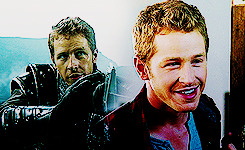
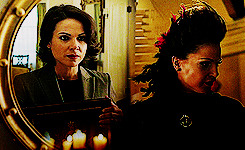
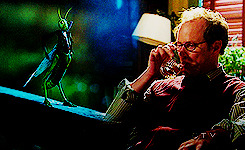
Rumpelstiltskin played by Scottish actor Robert Carlyle in "Once Upon A Time":


Rumpelstiltskin played by Scottish actor Robert Carlyle in "Once Upon A Time":
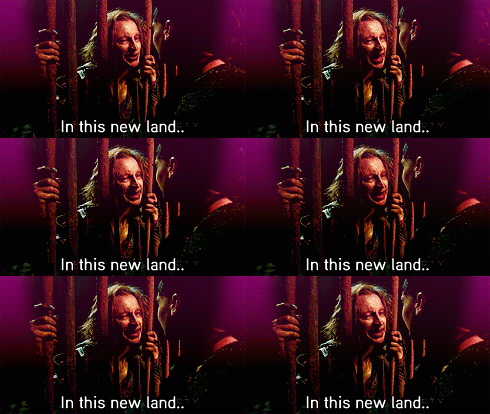
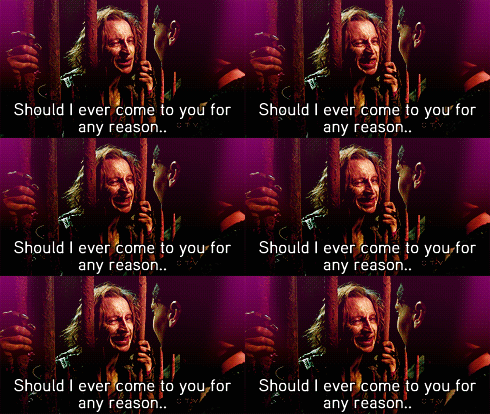
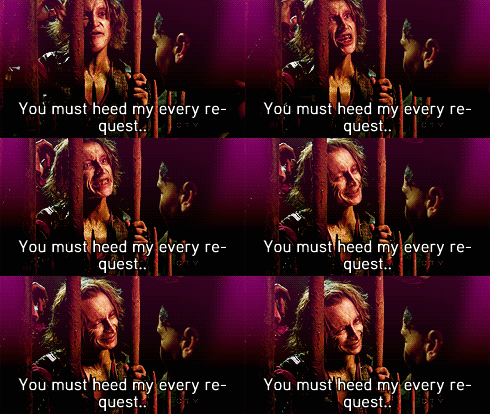
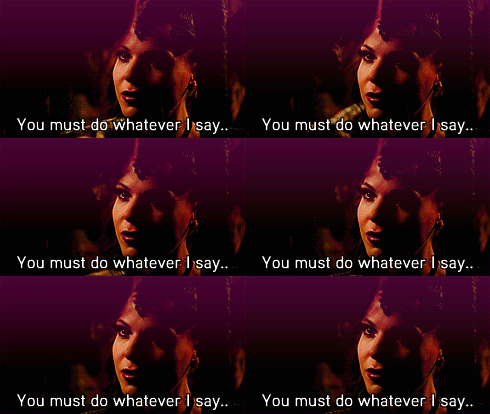

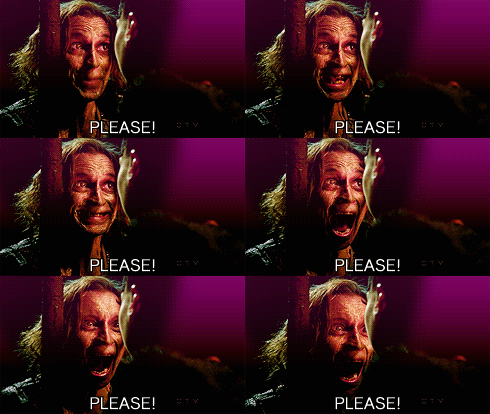
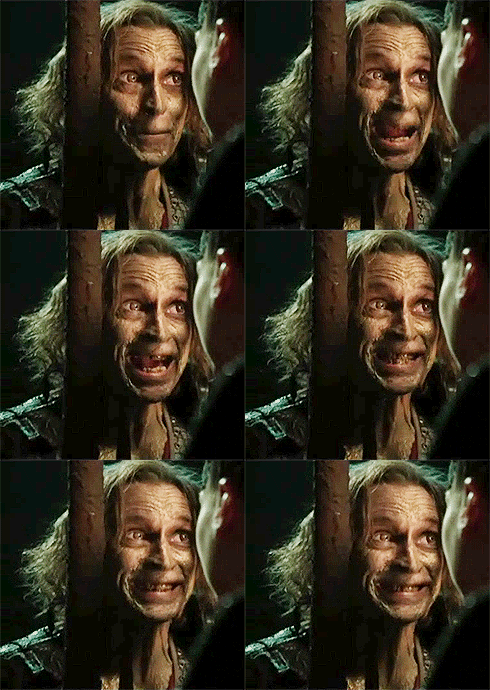
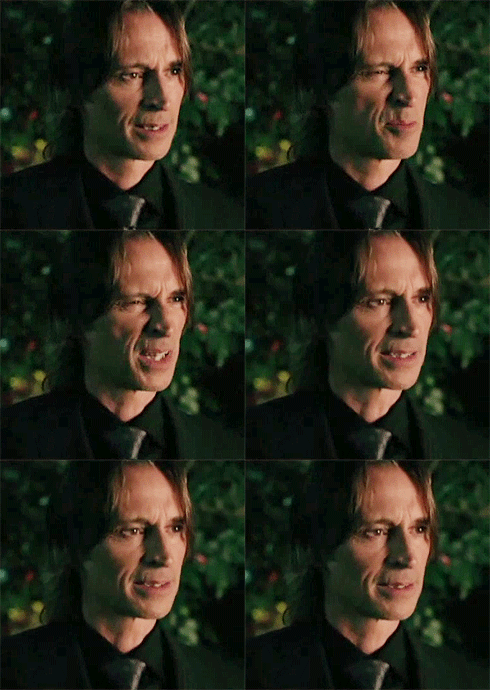
So good at being evil <3

Once Upon A Time, in order to make himself appear more important, a miller lied to a king, telling him that his daughter could spin straw into gold. The king called for the girl, shut her in a tower room with straw and a spinning wheel, and demanded that she spin the straw into gold by morning, for three nights, or be executed (other versions have the king threatening to lock her up in a dungeon forever). She had given up all hope, when an impish creature appeared in the room and spun straw into gold for her in return for her necklace, then again the following night for her ring. On the third night, when she had nothing with which to reward him, the strange creature spun straw into gold for a promise that the girl's first-born child would become his.
The king was so impressed that he married the miller's daughter, but when their first child was born, the imp returned to claim his payment: "Now give me what you promised". The queen was frightened and offered him all the wealth she had if she could keep the child. The imp refused but finally agreed to give up his claim to the child if the queen could guess his name in three days. At first she failed, but before the final night, her messenger discovered the imp's remote mountain cottage and, unseen, overheard the imp hopping about his fire and singing. While there are many variations in this song, the 1886 translation by Lucy Crane reads:- Today I brew, tomorrow I bake;
- And then the Prince child I will take;
- For no one knows my little game
- That Rumpelstiltskin is my name!
- (Wikipedia)
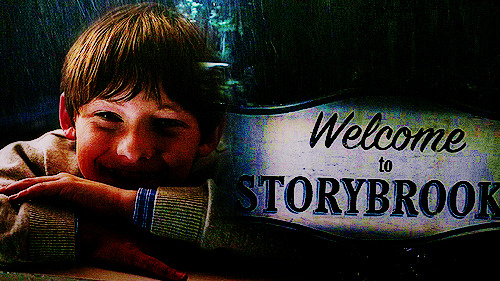
Once Upon A Time...

Storyline:
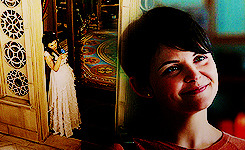
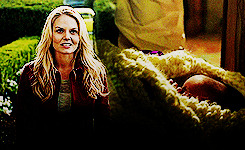
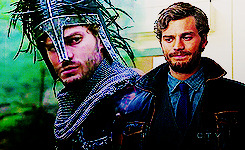
Emma Swan gets the surprise of her life when Henry, the son she gave up 10 years ago, arrives on her doorstep. Returning the boy to his adoptive mother becomes complicated when Henry reveals a stunning theory to Emma. Everyone in Storybrooke, Maine is a fairytale character under a curse, and Emma - as the long lost daughter of Snow White and Prince Charming - is the one who can save them all. The story unfolds; interweaving scenes of the drama in the sleepy New England town and the the inhabitants' past lives in the world of fairy tales. The timeless battle of good vs evil is ready to begin again.(imdb.com)
This is one of the best shows I've ever seen!
But guess what - It's been 7 episodes only... and my second favorite character is already dead ,HOWTHEFUCKISTHATEVENPOSSIBLE ????????????
;(((((((((
(GRIEF MODE).
awesome show anyway.


Dec 8, 2011

"Fear isn't so difficult to understand. After all, weren't we all frightened as children? Nothing has changed since Little Red Riding Hood faced the Big Bad Wolf. What frightens us today is exactly the same sort of thing that frightened us yesterday. It's just a different wolf. This fright complex is rooted in every individual."
- Alfred Hitchcock
Dec 7, 2011

Dec 6, 2011

Dec 3, 2011
"Fairy tale does not deny the existence of sorrow and failure: the possibility of these is necessary to the joy of deliverance. I denies (in the face of much evidence, if you will) universal final defeat... giving a fleeting glimpse of Joy; Joy beyond the walls of the world, poignant as grief."
- J. R. R. Tolkien

Dec 2, 2011


Dec 1, 2011
Bluebeard
Every fairy tale has its meaning - symbols hidden in the story, which are used to make clear what kind of a character the antagonist/protagonist is - usually if he/she is incredibly beautiful, he/she is also brave, kind-hearted and friendly, although there are cases when the appearance is deceitful - the beautiful girl is the bad witch who has cast a spell or has drunk potion in order to become beautiful, or the ugly frog is actually a handsome prince waiting for his princess to find him and judge him not by his appearance, but by his qualities.

The actions of the characters and the stories themselves were originally told in order to teach the children that they should, for example, never walk alone in the woods, or trust a stranger.
Children were also supposed to learn that great power comes with great responsibility, or that they should never give up, or stop believing in themselves etc.
The first fairy tale I'm going to post, is called "Bluebeard".
After the story there will be annotations about the story - the symbols in it and their meanings.
Well, here we go!
BLUEBEARD
THERE was a man who had fine houses, both in town and country, a deal of silver and gold plate, embroidered furniture, and coaches gilded all over with gold. But this man was so unlucky as to have a blue1 beard, which made him so frightfully ugly that all the women and girls ran away from him.
One of his neighbors, a lady of quality, had two daughters who were perfect beauties. He desired of her one of them in marriage, leaving to her choice which of the two she would bestow on him. They would neither of them have him, and sent him backward and forward from one another, not being able to bear the thoughts of marrying a man who had a blue beard,2 and what besides gave them disgust and aversion was his having already been married to several wives, and nobody ever knew what became of them.
Bluebeard, to engage their affection, took them, with the lady their mother and three or four ladies of their acquaintance, with other young people of the neighborhood, to one of his country seats, where they stayed a whole week.
There was nothing there to be seen but parties of pleasure, hunting, fishing, dancing, mirth, and feasting. Nobody went to bed, but all passed the night in rallying and joking with each other. In short, everything succeeded so well that the youngest daughter began to think the master of the house not to have a beard so very blue, and that he was a mighty civil gentleman.
As soon as they returned home, the marriage was concluded. About a month afterward, Bluebeard told his wife that he was obliged to take a country journey for six weeks at least, about affairs of very great consequence, desiring her to divert herself in his absence, to send for her friends and acquaintances, to carry them into the country, if she pleased, and to make good cheer wherever she was.
"Here," said he, "are the keys3of the two great wardrobes,wherein I have my best furniture; these are of my silver and gold plate, which is not every day in use; these open my strong boxes, which hold my money, both gold and silver; these my caskets of jewels; and this is the master-key to allmy apartments4 But for this little one here, it is the key of the closet at the end of the great gallery on the ground floor. Open them all; go into all and every one of them, except that little closet, which I forbid you, and forbid it in such a manner that, if you happen to open it, there's nothing but what you may expect from my just anger and resentment."5
She promised to observe, very exactly, whatever he had ordered; when he, after having embraced her, got into his coach and proceeded on his journey.
Her neighbors and good friends did not stay to be sent for by the new married lady, so great was their impatience to see all the rich furniture of her house, not daring to come while her husband was there, because of his blue beard, which frightened them. They ran through all the rooms, closets, and wardrobes, which were all so fine and rich that they seemed to surpass one another.
After that they went up into the two great rooms, where was the best and richest furniture; they could not sufficiently admire the number and beauty of the tapestry, beds, couches, cabinets, stands, tables, and looking-glasses6,in which you might see yourself from head to foot; some of them were framed with glass, others with silver, plain and gilded, the finest and most magnificent ever were seen.
They ceased not to extol and envy the happiness of their friend, who in the meantime in no way diverted herself in looking upon all these rich things, because of the impatience she had to go and open the closet on the ground floor. She was so much pressed by her curiosity7 that, without considering that it was very uncivil to leave her company, she went down a little back staircase, and with such excessive haste that she had twice or thrice like to have broken her neck.
Coming to the closet-door, she made a stop for some time, thinking upon her husband's orders, and considering what unhappiness might attend her if she was disobedient; 8but the temptation9 was so strong she could not overcome it. She then took the little key, and opened it, trembling, but could not at first see anything plainly, because the windows were shut. After some moments she began to perceive that the floor was all covered over with clotted blood,10 on which lay the bodies of several dead women, ranged against the walls. (These were all the wives whom Bluebeard had married and murdered, one after another.) She thought she should have died for fear, and the key, which she pulled out of the lock, fell out of her hand.
After having somewhat recovered her surprise, she took up the key, locked the door, and went upstairs into her chamber to recover herself; but she could not, she was so much frightened. Having observed that the key of the closet was stained with blood,11 she tried two or three times to wipe it off, but the blood would not come out; in vain did she wash it, and even rub it with soap and sand;12 the blood still remained, for the key was magical and she could never make it quite clean; when the blood was gone off from one side, it came again on the other.
Bluebeard returned from his journey the same evening, and said he had received letters upon the road, informing him that the affair he went about was ended to his advantage. His wife did all she could to convince him she was extremely glad of his speedy return.13
Next morning he asked her for the keys, which she gave him, but with such a trembling hand that he easily guessed what had happened.
"What!" said he, "is not the key of my closet among the rest?"
"I must certainly have left it above upon the table," said she.
"Fail not to bring it to me presently," said Bluebeard.
After several goings backward and forward she was forced to bring him the key. Bluebeard, having very attentively considered it, said to his wife, "How comes this blood upon the key?"
"I do not know," cried the poor woman, paler than death.
"You do not know!" replied Bluebeard. "I very well know. You were resolved to go into the closet, were you not? Mighty well, madam; you shall go in, and take your place among the ladies you saw there."
Upon this she threw herself at her husband's feet, and begged his pardon with all the signs of true repentance,14 vowing that she would never more be disobedient. She would have melted a rock, so beautiful and sorrowful was she; but Bluebeard had a heart harder than any rock!15
"You must die, madam," said he, "and that presently."
"Since I must die," answered she (looking upon him with her eyes all bathed in tears), "give me some little time to say my prayers."
"I give you," replied Bluebeard, "half a quarter of an hour, but not one moment more."
When she was alone she called out to her sister, and said to her: "Sister Anne"16 (for that was her name), "go up, I beg you, upon the top of the tower, and look if my brothers are not coming over; they promised me that they would come today, and if you see them, give them a sign to make haste."
Her sister Anne went up upon the top of the tower, and the poor afflicted wife cried out from time to time: "Anne, sister Anne, do you see anyone coming?"
And sister Anne said: "I see nothing but the sun, which makes a dust, and the grass, which looks green."
In the meanwhile Bluebeard, holding a great sabre17 in his hand, cried out as loud as he could bawl to his wife: "Come down instantly, or I shall come up to you."
"One moment longer, if you please," said his wife, and then she cried out very softly, "Anne, sister Anne, dost thou see anybody coming?"
And sister Anne answered: "I see nothing but the sun, which makes a dust, and the grass, which is green."
"Come down quickly," cried Bluebeard, "or I will come up to you."
"I am coming," answered his wife; and then she cried, "Anne, sister Anne, dost thou not see anyone coming?"
"I see," replied sister Anne, "a great dust, which comes on this side here."
"Are they my brothers?"
"Will you not come down?" cried Bluebeard.
"One moment longer," said his wife, and then she cried out: "Anne, sister Anne, dost thou see nobody coming?"
"I see," said she, "two horsemen, but they are yet a great way off."
"God be praised," replied the poor wife joyfully; "they are my brothers; I will make them a sign, as well as I can, for them to make haste."
Then Bluebeard bawled out so loud that he made the whole house tremble. The distressed wife came down, and threw herself at his feet, all in tears, with her hair about her shoulders.
"This signifies nothing," says Bluebeard; "you must die"; then, taking hold of her hair with one hand, and lifting up the sword with the other, he was going to take off her head. The poor lady, turning about to him, and looking at him with dying eyes, desired him to afford her one little moment to recollect herself.
"No, no," said he, "recommend thyself to God," and was just ready to strike . . .
At this very instant there was such a loud knocking at the gate that Bluebeard made a sudden stop. The gate was opened, and presently entered two horsemen, who, drawing their swords, ran directly to Bluebeard. He knew them to be his wife's brothers, one a dragoon,18 the other a musketeer, so that he ran away immediately to save himself; but the two brothers pursued so close that they overtook him before he could get to the steps of the porch, when they ran their swords through his body and left him dead. The poor wife was almost as dead as her husband, and had not strength enough to rise and welcome her brothers.
Bluebeard had no heirs,19 and so his wife became mistress of all his estate. She made use of one part of it to marry her sister Anne to a young gentleman who had loved her a long while;20 another part to buy captains commissions for her brothers, and the rest to marry herself to a very worthy gentleman, who made her forget the ill time she had passed with Bluebeard.
by Charles Perrault
Lang, Andrew, ed. "Bluebeard." The Blue Fairy Book.New York: Dover, 1965. (Original published 1889.)
Annotations:
1.blue - The deepest color, "blue is the most insubstantial color and seldom occurs in the natural world except as a translucency. It is considered empty, or austere, pure, and frosty. It is also the coldest color. Indifferent and unafraid, centered solely upon itself, blue is not of this world: it evokes the idea of eternity, calm, lofty, superhuman, inhuman even" (Chevalier 1982). Many of these symbolic qualities of blue apply well to Bluebeard who is cold with his murderous nature. His blue beard causes people to fear him as an unnatural color for a beard or most things in the natural world.
2.beard - A beard or hair has many symbolic meanings. First of all, it is often connected with magical powers. It is also considered a sign of invulnerability, like the Bible figure of Samson. In connection with Bluebeard, hair is "the sign of the animal in the human, and all that means in terms of our tradition of associating the beast with the bestial" (Warner 1994). With all of these meanings in mind, Bluebeard's beard shows that he has great power and is bestial in nature. The fact that the beard is also blue emphasizes his unnatural and magical qualities.
3. keys - The keys in this story have many symbolic meanings. First, a key is a symbol of power and/or wealth. Keys are used to lock away what is valuable. A key provide access to goods which are locked away to anyone who possesses it. Often in folktales, a key symbolizes a mystery to be solved "on the road to enlightenment and revelation" (Chevalier 1982). In this context the key represents a mystery to the bride which must be solved. Bluebeard gives her the key to give her access and power in her new home. The privilege is double-edged for he forbids her access to one room conveying his lack of trust in her. Essentially, the key is a trap in this tale, for use of the forbidden key will bring a death sentence. We must also remember that the wife will use the key to open the forbidden chamber and thus she will receive a revelation about the true nature of her husband. Finally, the key is also a phallic symbol which is often emphasized in illustrations as overly sized. The wife is flirting with sexual knowledge and perhaps promiscuity by accepting the key from her husband (Warner 1994).
4. apartments - An apartment is a room in a palace, anappartement in French (Webster's 1990).
5. "my just anger and resentment" - Bettelheim addresses this aspect of the story in his interpretation of the tale. He considers Bluebeard's anger to be just since his wife betrays him, but the extreme nature of his anger is where Bluebeard's fault is found. He states: "The story tells that although a jealous husband may believe a wife deserves to be severely punished--even killed--for this, he is absolutely wrong in such thoughts" (Bettelheim 1975). This translation from Andrew Lang's The Blue Fairy Book reflects the Victorian attitude towards infidelity and the resulting anger. Zipes' modern translation uses: "My anger will exceed anything you have ever experienced" (Zipes 1989).
6. looking-glasses - A looking-glass or mirror has many symbolic meanings of truth and representation of a person's heart, but in this case the mirror is most significant as a symbol of wealth. In the past, mirrors were expensive and a luxury reserved for the wealthy. The fact that Bluebeard owns many with intricate and costly frames that are large enough to give a full reflection of a person from head to toe shows that he is extremely wealthy and thus powerful (Chevalier 1982).
7. curiosity - Curiosity is a common theme in fairy tales and literature. Some critics consider the central theme of this story to be a caution against female curiosity. According to Bettelheim, this story "presents in the most extreme form the motif that as a test of trustworthiness, the female must not inquire into the secrets of the male" (Bettelheim 1975). Although Perrault did not add the subtitle, many later versions of the story have added subtitles such as "The Effects of Female Curiosity" or "The Fatal Effects of Female Curiosity" (Warner 1994). The theme of curiosity's danger is best known in the story of Pandora's box in which all of the evils of the world were released when a box was opened by Pandora or her husband, depending on the version of the story (Murphy 1996). Finally, the classic story of Cupid and Psyche, with which many fairy tales share story elements and themes, contains a cautionary theme against curiosity, too.
8. disobedient - Connected to the curiosity themes, this story warns readers or listeners of the effects of disobedience. The wife will be threatened with death by her husband for her disobedience. She will later repent of her transgression. The positive results of her repentance will be discussed in future notes.
9. temptation - Temptation is related to the curiosity and disobedience themes in the story. For some critics, the tale is a cautionary one against woman's innate wickedness that leads to the betrayal and ultimate destruction of her husband. This theme is once again present in the story of Pandora's box. It also alludes to the temptation story in the Garden of Eden in which Eve partakes of the forbidden fruit and thus gains knowledge forbidden by God the Father (Warner 1994). Christine Daae contends that the tale does not warn "against the moral consequences of sex, but of the practical consequences." In the days when childbearing was a principle cause of death, a husband essentially killed his wife by making her pregnant. In this way, Bluebeard is a story of everyday life (Daae 1998).
10. blood - Blood is rich with symbolic meanings. Blood is passion and the medium of life. That is has been so carelessly allowed to collect on the floor shows Bluebeard's total disrespect for life. Even in ritual sacrifice great care is taken to keep blood from spilling on the ground (Leach 1949). Bluebeard has no such concerns and the murders he has committed have no resemblance to blood sacrifices or any other ritual. The abundance of blood verifies that the bodies within the chamber are of real women who died as their blood was loosed from their bodies. The image is quite horrific.
11. stained with blood - Bettelheim believes that the stained key confirms the wife's sexual infidelity since it is an ancient motif for a terrible sin, usually murder, but of which sexual defloration is another possible meaning. The key represents the male sexual organ which will be stained with blood when the hymen is broken. The blood is permanent since defloration is an irreversible event (Bettelheim 1975). Beyond Bettelheim, the key has undoubtedly become stained from the sin of the wife however extreme a sin it might appear to the reader.
12. sand - Sand was a common abrasive cleaner in past centuries. The fact that not even soap or sand will remove the stain confirms that it is permanent. Some cultures use sand for ritual ablution since it "flows like water and burns like fire" (Chevalier 1982).
13. speedy return - The speedy return of Bluebeard confirms that his trip was a ruse to give him the opportunity to test his wife's faithfulness. Bettelheim thinks that a sexual indiscretion has taken place in Bluebeard's absence (Bettelheim 1975). Undoubtedly the wife has disobeyed her husband, but the extent of her disobedience or betrayal is not apparent beyond the fact that she opened the door to the forbidden room. It is sure that Bluebeard counted on his wife's betrayal and set up the trap to quickly confirm it.
14. repentance - The first religious allusion in the story, this fairy tale also imparts the message that repentance and forgiveness are dynamic terms. The wife is disobedient, but she repents of her sin (out of fear, perhaps, but the emotion is called repentance all the same). Next she receives mercy, although not from her husband who dies for his inability to forgive her for her transgressions.
15. rock - The metaphor comparing Blue Beard's heart to a rock is a simple allusion to his impenetrable and unforgiving nature. Ironical comparison also exists with the reference to repentance in the previous lines. Jehovah is called the "Rock of Israel" but he is also capable of forgiveness while Bluebeard is not (Chevalier 1982). The metaphor ultimately shows that Bluebeard is worthy of destruction in his pride and immaleable nature while the wife is capable of repentance and mercy.
16. Anne - Anne has a name as does Bluebeard, but the wife does not. Anne is the only character to have a name which is not descriptive of her role (wife) or physical appearance (Bluebeard). The greatest significance of the name is the possible allusion to Saint Anne and/or Anne of Austria, Queen of France, mother of Louis XIV. Queen Anne's devotion to Saint Anne, the legendary mother of the Virgin Mary, gave rise to the cult of Saint Anne in the 1600s. Saint Anne was popular and known as a miracle worker among the French. She was declared a patron saint to Brittany as a result and was thus a well-known figure to its inhabitants (Warner 1994).
17. sabre - The sabre is an interesting element in this translation. (Zipes uses "cutlass" in his translation.) Either weapon leads to the frequent portrayal of Bluebeard as a Turk or other stereotypical "infidel" to explain his terrible behavior. Bluebeard often wears turbans in illustrations, although not in the Dore illustrations seen here, to enhance the image (Warner 1994).
18. dragoon - A dragoon is a "mounted infantryman armed with a carbine which is a short, light rifle" (Webster's 1990). However, this soldier also wields a sword to kill Bluebeard.
19. heirs - The fact that Bluebeard has no heirs except his surviving wife suggests that he was incapable of allowing those near him to live long. It also makes it possible for his wife to inherit the estate, since ownership of property was rare and discouraged through primogeniture (estate to the firstborn son) and entailment. These practices were meant to keep wealth, especially lands, within in the family and to keep property from leaving the family through marriage (Pool 1993). In the end, the wife inherits the entire property and is thus able to live happily ever after.
20. who had loved her a long while - Perrault and many of his female contemporaries who wrote fairy tales championed women's issues, such as arranged and/or loveless marriages. The fact that Anne is able to marry a man who has loved her a long time implies they were unable to marry due to poor fortune. Now that her sister has money, Anne and her lover are able to marry for love, a rare and appealing idea at the time this story was first recorded. The situation of Anne's marriage emphasizes the happy ending as well as the ideology of Perrault (Zipes 1989). The fact that Anne had a previous lover also suggests why she was not attracted to Bluebeard as her sister was.
Subscribe to:
Posts (Atom)